The Ultimate Guide to AI Content Optimization
Why AI Content Optimization Matters for Your Business
AI content optimization is the practice of structuring and refining your content so that AI assistants like ChatGPT, Perplexity, and Google’s AI Overviews can accurately extract, summarize, and cite your answers. Here’s what you need to know:
- What it is: Using AI tools and techniques to improve content for both traditional search engines and AI-powered answer engines
- Why it matters: AI referrals to websites spiked 357% year-over-year, reaching 1.13 billion visits in June 2025
- Key difference: Instead of just ranking pages, AI optimization focuses on making your content reusable in AI-generated responses
- Core goal: Get your business mentioned and cited when potential customers ask AI assistants for recommendations
If you’ve noticed your Google traffic declining or wondered why competitors appear in ChatGPT results while you don’t, you’re facing the shift to AI search. Over 7 million blog posts are published daily, yet most remain invisible to the AI tools your customers now rely on.
The good news? 86% of SEOs now use AI tools in their strategies, and 65% report improved results. AI content optimization isn’t about replacing human creativity—it’s about making your existing expertise more discoverable.
Traditional SEO focused on keywords and backlinks. AI optimization adds layers: search intent alignment, content structure for machine parsing, semantic clarity, and extractability. When a potential customer asks ChatGPT “What’s the best marketing agency near me?” or Perplexity “How do I improve my website traffic?”—your goal is to be in that answer.
Companies applying these techniques see real results. One B2B firm achieved a 187% organic traffic increase and 68% conversion boost by aligning content with how AI systems extract and present information. Another grew blog sessions by 810% using AI-driven optimization during a challenging domain migration.
The content creation market reached over $13 billion by 2022, but volume alone doesn’t win. 70% of marketers say AI tools help them speed up production—yet speed without optimization means invisible content. You need both.
Understanding AI Content Optimization and Its Core Benefits
To truly master the digital landscape, we have to recognize that $13 billion Content creation is a huge business. However, producing content that ranks highly is becoming increasingly complex. This is where AI content optimization comes in.
At its core, AI content optimization is the process of using artificial intelligence to analyze, enhance, and structure content to satisfy both search engine algorithms and the needs of human readers. It’s no longer just about stuffing keywords into a paragraph; it’s about using data-driven insights to ensure your content is the most relevant answer to a user’s query.
The adoption rates speak for themselves: 86% of SEOs now rely on AI tools, and 70% of marketers utilize tools like ChatGPT or CopyAI to accelerate their workflows. By leveraging these technologies, we can achieve:
- Scalability: We can optimize hundreds of pages in the time it used to take to do ten.
- Data-Driven Insights: AI can scan thousands of top-performing pages to identify exactly what your content is missing.
- Real-Time Analysis: Instead of waiting weeks for rankings to change, AI helps us predict performance before we even hit “publish.”
- Competitive Edge: AI reveals “content gaps”—topics your competitors aren’t covering—giving you a clear path to the top of the SERPs.
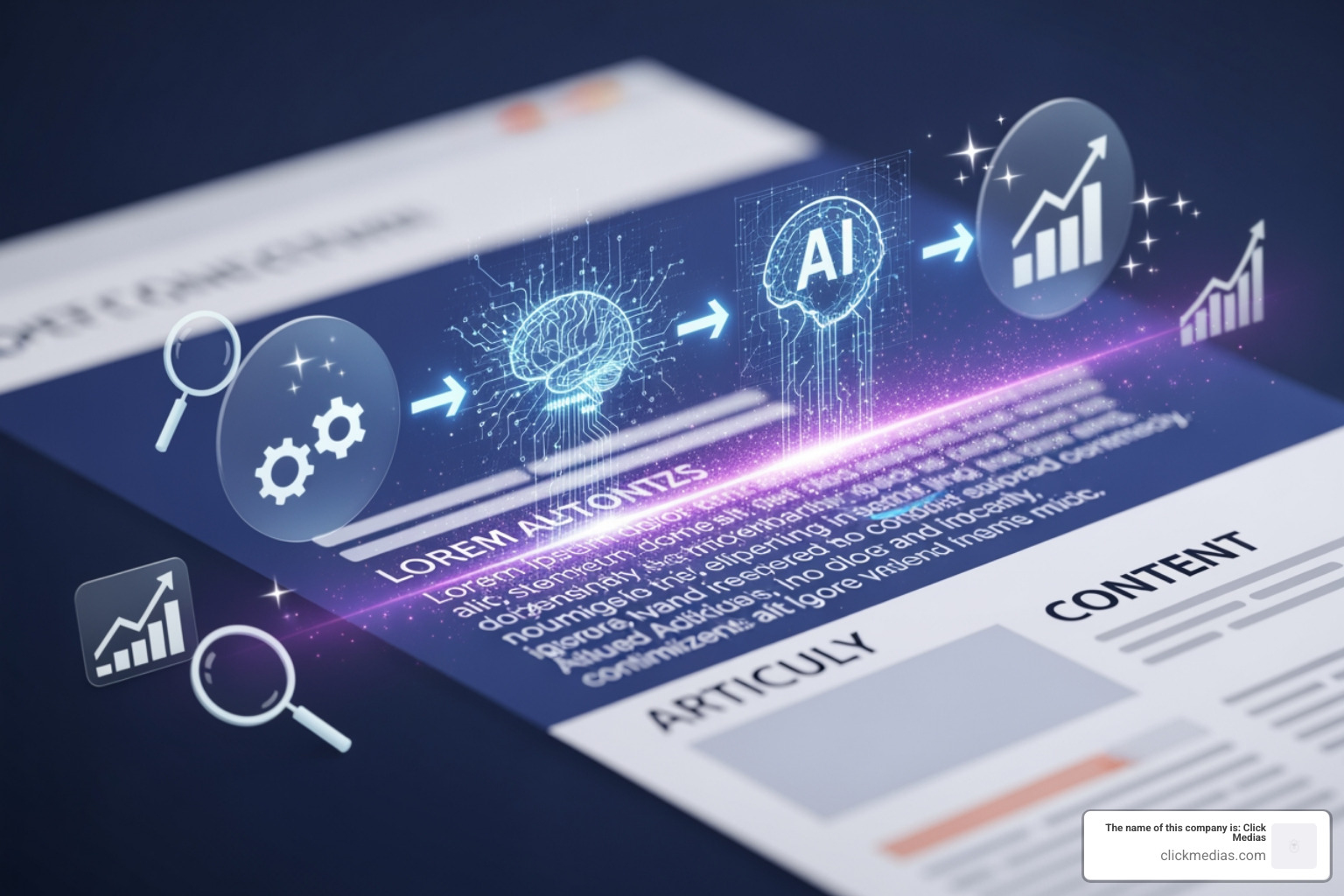
Leveraging AI Content Optimization for On-Page SEO
On-page SEO has evolved from a manual checklist into a sophisticated science. Using AI content optimization, we can now pinpoint opportunities that were previously invisible.
- Secondary Keywords & Clusters: Gone are the days of targeting one keyword per page. AI helps us identify “semantic neighbors”—terms that are contextually related to your main topic. By building keyword clusters, we signal to search engines that our content has high “topical authority.”
- Internal Linking: AI tools can audit your entire site to find pages that need more “link juice” and suggest the perfect anchor text to connect them.
- Metadata & Titles: We can use AI to generate dozens of title variations, ensuring they stay under the 60-character limit to avoid truncation while maximizing click-through rates.
- Readability: AI can flag “cognitive load” issues—sentences that are too long or complex—and suggest simpler alternatives that keep readers engaged.
- Technical Clarity: One of the most important steps is using schema.org. This code helps AI systems and search engines understand the “entities” on your page, such as products, FAQs, or reviews, making your content much easier for an LLM (Large Language Model) to parse and cite.
AI vs. Traditional SEO: A New Era of Search
We often get asked: “Is SEO dead?” Our answer is always a resounding “No, but it has changed.” Traditional SEO was built on a foundation of “blue links”—you rank #1, and people click. AI search (often called AEO or Answer Engine Optimization) is about becoming the answer itself.
| Feature | Traditional SEO | AI Content Optimization |
|---|---|---|
| Primary Goal | Rank in top 10 blue links | Be cited in AI-generated answers |
| Core Metric | Keyword density & Backlinks | Extractability & Semantic clarity |
| Focus | Search volume | Search intent & Sentiment |
| Structure | Standard HTML | Machine-parsable (Schema, Lists, Tables) |
| User Journey | Click -> Read | Ask -> Receive Answer |
The shift is driven by semantic analysis. Traditional search engines looked for matching words; AI looks for matching meaning. It considers user behavior, search trends, and even the sentiment of your writing. If your content is structured for machine parsing, it’s far more likely to be selected for a featured snippet or an AI overview.
Strategic Implementation for AI Search Visibility
If you want your content to be the “go-to” source for an AI assistant, you need to change how you write. We recommend a “Machine-First, Human-Centric” approach.
One of the most effective tactics is the BLUF (Bottom Line Up Front) method. AI assistants are “answer engines”; they want to find the answer immediately. By placing a concise, one-to-two sentence summary at the very beginning of your section, you provide a “ready-to-use” snippet for the AI to extract.
To truly win, you must How to Optimize your Owned Content for AI Search. This involves:
- Extractability: Use lists, tables, and short paragraphs. AI models find it much easier to pull data from a table than from a “wall of text.”
- Provenance and Freshness: AI models prioritize content that is up-to-date and has a clear author. Including a “Last Updated” date and a detailed author bio builds trust with the retrieval system.
- Q&A Formats: Frame your subheadings as questions. For example, instead of “Dishwasher Noise Levels,” use “How loud is the 42 dB dishwasher?” This mirrors how users actually talk to AI.
- Semantic Clarity: Avoid jargon and decorative symbols. Keep your punctuation simple so the machine can parse your logic without getting confused.
Maximizing Visibility with AI Content Optimization
When we talk about visibility today, we aren’t just talking about Google. Platforms like Perplexity and ChatGPT are becoming primary search tools. These “answer engines” have unique citation behaviors. They don’t just find information; they look for entities and technical clarity.
According to the Latest research on AI-generated summaries, users often prefer the summarized format for quick fact-finding. To be the source of that summary, your content needs to be “citable.” This means providing original data, unique insights, and clear definitions.
We also see a move toward multimodal content. AI isn’t just reading your text anymore; it’s looking at your images (via alt text) and your videos. Ensuring every piece of media on your page is optimized with descriptive, keyword-rich metadata is essential for 360-degree visibility.
Best Practices, Pitfalls, and the Human Element
While AI is a powerful assistant, it is a terrible master. One of the biggest pitfalls we see is “over-optimization”—content that sounds like it was written by a robot, for a robot. This is a fast track to failing Google’s E-E-A-T (Experience, Expertise, Authoritativeness, and Trustworthiness) standards.
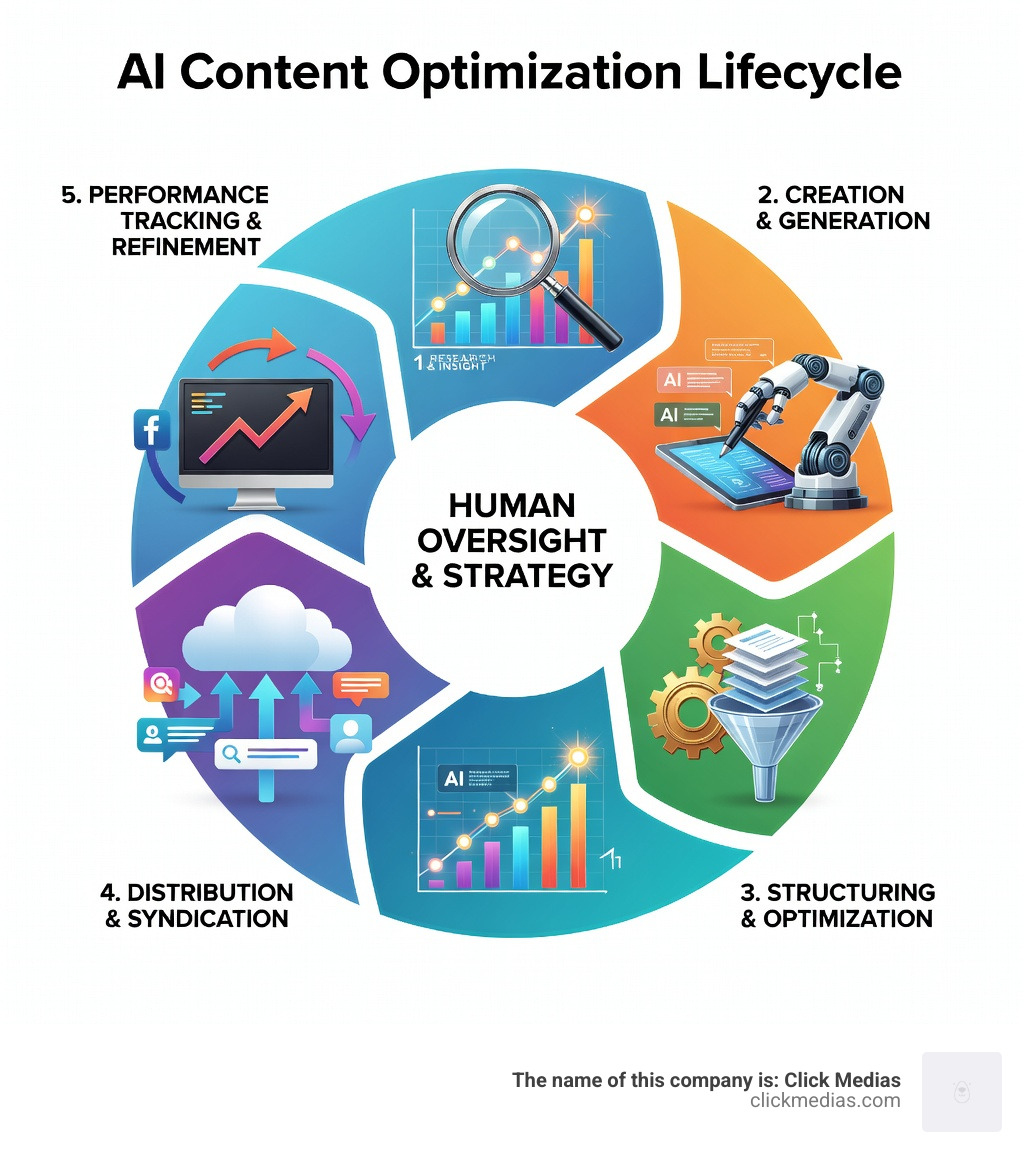
Human editing is the “secret sauce” of AI content optimization. A human editor can:
- Fix Hallucinations: AI can sometimes make up facts (hallucinate). A human must verify every statistic and claim.
- Inject Brand Voice: AI tends to be generic. We need humans to add the wit, warmth, and unique perspective that makes a brand memorable.
- Ensure Accuracy: An AI humanizer can help smooth out robotic phrasing, but a professional linguist from a service like BLEND’s online Wizard can ensure your content resonates emotionally with a global audience.
We recommend a “Source-Gated Drafting” process: never allow an AI to make a claim without a corresponding URL or source note in your internal draft. This ensures every piece of content we produce is grounded in reality.
Future Trends in AI Content Optimization
The future of content is hyper-personalized. Soon, AI will not only help us write content but will dynamically adjust that content for the specific person reading it.
- Predictive Analytics: We will use AI to identify high-performing topics before they even start trending.
- Voice Search: As more people use smart speakers, our content must be optimized for “natural language” queries—long, conversational sentences.
- Automated Distribution: AI will eventually decide the best time and platform to post your content to ensure maximum engagement.
- Performance Tracking: Tools will move beyond simple “rankings” to track “share of voice” within AI summaries and citation frequency across different LLMs.
Frequently Asked Questions about AI Content Optimization
What is the difference between AI content optimization and traditional SEO?
Traditional SEO focuses on helping a search engine find your page among millions of others using keywords and links. AI content optimization focuses on helping an AI model understand and reuse your content. It’s the difference between being a book in a library and being the specific quote a researcher uses in their paper.
How does AI help with keyword research and clustering?
AI can process millions of search queries in seconds to find patterns. It identifies “keyword clusters”—groups of related terms that humans might miss. For example, if you’re writing about “remote work,” AI might suggest clustering it with “cybersecurity for home offices” and “asynchronous communication tools” to build total topical authority.
Can AI content optimization help my site get cited by ChatGPT or Perplexity?
Yes! By using structured data (Schema), clear headings, and the BLUF method, you make it easy for these models to extract your information. When you provide clear, fact-based answers that are easy for a machine to parse, you significantly increase your chances of being the “cited source” in an AI response.
Conclusion
The world of search is changing, but the goal remains the same: getting your message in front of the people who need it. At Click Medias, we specialize in AI Search Optimization (AISO). We don’t just look at where you rank on Google today; we look at how you’ll be discovered by the AI models of tomorrow.
By combining traditional SEO fundamentals—like high-quality backlinks and technical audits—with cutting-edge AI content optimization, we help our clients achieve measurable growth and a lasting competitive edge. Whether it’s through AI Search Optimization (AISO) or our comprehensive content audits, we ensure your brand is heard in the age of AI.
Ready to make your content future-proof? More info about AI Search Optimization services is just a click away. Let’s build a strategy that turns AI search into your biggest traffic driver.
