Ranking in the Age of LLMs: A Guide to AI Search Results
Why AI Search Is Reshaping How Content Gets Finded
How to optimize content for ai search requires structuring your content for AI crawlers, building citation-worthy authority signals, and implementing schema markup that AI engines can parse and reference. Here’s the quick answer:
Core AI Search Optimization Steps:
- Structure content with clear H2/H3 headings – Pages with logical hierarchy are 40% more likely to be cited by AI engines
- Answer questions directly upfront – Opening paragraphs that address queries immediately get cited 67% more often
- Add original data and statistics – Tables with unique data earn 4.1x more AI citations
- Implement schema markup – FAQ and Article schema increase citations by 28%
- Build E-E-A-T signals – Author bios, expert credentials, and authoritative sources boost citation-worthiness
- Configure robots.txt for AI crawlers – Allow GPTBot, PerplexityBot, and Google-Extended to access your content
- Keep content fresh – Pages updated in the last 30 days earn 3.2x more citations
If you’re a small business owner watching your Google traffic decline, you’re not imagining things. AI-powered search has already arrived – and it’s changing everything about how customers find businesses like yours.
Google’s AI Overviews now reach 2 billion monthly users. ChatGPT serves 800 million users every week. Perplexity processed 780 million queries in a single month. These aren’t future projections – this is happening right now.
The challenge? When someone asks ChatGPT or Perplexity to recommend a solution, these AI engines cite just 2-7 domains per response – far fewer than the 10 blue links in traditional search. If your content isn’t optimized for AI findy, you’re invisible to a massive and growing audience.
The good news: Most of what makes content AI-friendly also makes it better for humans. Clear structure, direct answers, authoritative data, and logical flow help both AI engines and real people understand your expertise.
This guide walks you through the practical steps to optimize your content for AI search – what researchers at Princeton University call Generative Engine Optimization (GEO). You’ll learn how to structure content so AI engines can find it, parse it, and cite it as a trusted source.
Understanding GEO: How to Optimize Content for AI Search vs. Traditional SEO
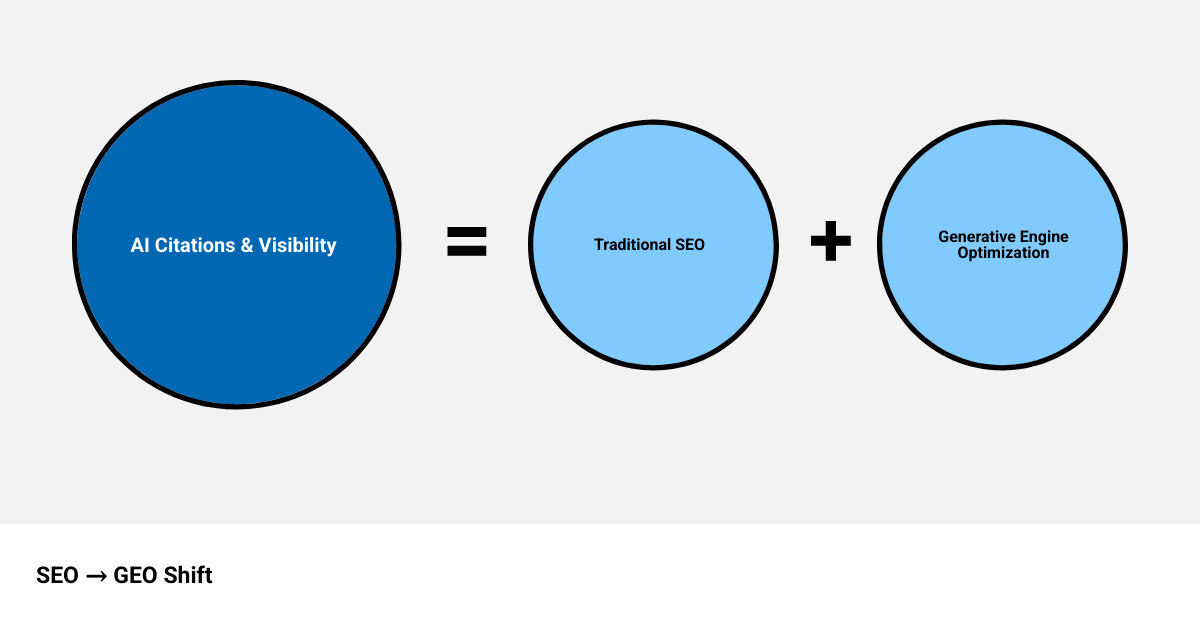
Generative Engine Optimization (GEO) is the new frontier of digital marketing. While traditional SEO was built to help search engines rank a list of blue links, GEO is designed to help Large Language Models (LLMs) synthesize your information into a direct answer.
The fundamental shift here is from “ranking” to “citation.” In the old world, we fought for position #1. In the AI world, we fight to be the source the AI uses to build its response. This requires a deep understanding of scientific research on AI search principles, which highlights that AI engines don’t just look for keywords—they look for “factual spans” and “citation-worthy” content.
One major technical difference is Query Fan-out. In traditional search, a user types a query, and the engine finds matching pages. In AI search, the engine often breaks a single user query into multiple sub-queries (fan-out), retrieves different “chunks” of information from across the web, and then performs Content Synthesis to create a unified response. To win here, your “reference rate”—the frequency with which AI models cite your brand—becomes the most important metric.
| Feature | Traditional SEO | AI Search (GEO) |
|---|---|---|
| Primary Goal | Rank in the top 10 blue links | Earn citations in synthesized answers |
| Unit of Optimization | The entire web page | Content “chunks” and factual spans |
| Primary Signal | Backlinks and keywords | Semantic relevance and authority |
| User Intent | Navigational/Informational | Conversational and Task-oriented |
| Success Metric | Click-Through Rate (CTR) | Citation Share of Voice & Reference Rate |
Technical Foundations for AI Crawlability and Indexability
Before an AI can cite you, its “bot” must be able to read your site. Unlike Googlebot, which has decades of infrastructure, many AI crawlers are newer and, frankly, less efficient. In fact, research shows AI crawlers are roughly 47 times less efficient than traditional crawlers, often timing out if a page takes more than 5 seconds to load.
To ensure you aren’t invisible, you must explicitly allow these bots. Your robots.txt configuration for AI crawlers should be updated to welcome agents like GPTBot (OpenAI), PerplexityBot, ClaudeBot, and Google-Extended.
Beyond robots.txt, we recommend three technical pillars:
- Server-Side Rendering (SSR): Many AI bots do not execute JavaScript well. If your content is tucked behind a “Read More” button or requires JS to load, the AI might see a blank page. Ensure your core content is in the initial HTML source.
- The llms.txt Specification: A new standard is emerging. By creating an llms.txt specification file, you provide a markdown-based summary of your site specifically designed for LLMs to ingest.
- Content Freshness: AI engines prioritize recent data. Content updated within the last 30 days is 3.2x more likely to be cited. Adding visible “Last Updated” timestamps helps bots recognize your relevance.
Structuring Content for Chunk-Level Retrieval and RAG
AI engines use a process called Retrieval-Augmented Generation (RAG). Instead of memorizing the whole internet, the AI searches for specific “chunks” of text that answer a user’s prompt and brings them into its “context window” to write a reply.
This means we need to stop writing long, rambling walls of text. Instead, we should focus on chunk-level optimization insights, which suggest writing in modular, self-contained sections. Each section should cover one idea, contain high information density, and maintain semantic clarity. If an AI “clips” a 200-word paragraph from your site, that paragraph must make sense on its own without the rest of the page.
How to optimize content for ai search using structured data
If you want to move from being “text” to being “data,” you need Schema.org. Schema is a specialized code (JSON-LD) that tells the AI exactly what it’s looking at. Think of it as a nutrition label for your content.
When you use FAQ schema or Article schema, you are providing the AI with a pre-verified fact sheet. Research shows that implementing proper schema leads to a 28% increase in AI citations. We recommend using the Schema markup validator to ensure your code is error-free. Once implemented, check your progress with the Rich result tester to see how Google and other engines interpret your structured data.
How to optimize content for ai search with modular formatting
Structure isn’t just for code; it’s for visual layout too. AI models are trained on structured data, so they find it much easier to parse information that follows a logical hierarchy.
- H2/H3 Hierarchy: Use descriptive headings. Instead of “Introduction,” use “How to Optimize Content for AI Search in 2025.” Pages with clear heading structures are 40% more likely to be cited.
- Direct Answers Upfront: Use the “Inverted Pyramid” style. Answer the primary question in the first paragraph. This practice leads to a 67% citation boost.
- Bulleted Lists and Tables: These are goldmines for AI. Content that includes original data tables earns 4.1x more AI citations. Tables provide the “ground truth” that LLMs love to synthesize into comparison charts for users.
Building E-E-A-T and Citation-Worthiness
In the age of AI, “Expertise, Experience, Authoritativeness, and Trustworthiness” (E-E-A-T) are more than just SEO buzzwords—they are the requirements for entry. Because LLMs are prone to “hallucinations,” they are programmed to prioritize sources that show clear signs of human expertise.
One of the easiest ways to boost your citation performance is by adding original statistics. Including unique data or survey results boosts citation frequency by more than 5.5%. AI engines are constantly looking for new “facts” to add to their knowledge base; if you are the primary source of a statistic, you become the primary candidate for a citation.
Authorship is also making a massive comeback. Detailed author bios that link to professional credentials help AI engines verify the “Expertise” part of the equation. You can learn more about E-E-A-T and authorship impact to see how Google is doubling down on this signal.
Finally, don’t forget Multi-modal content. AI isn’t just reading text anymore; it’s “seeing” images and “watching” videos. Adding descriptive alt text and captions to your images allows AI agents to include your visuals in their responses, further increasing your brand’s real estate in the AI interface.
Monitoring Performance and Share of Voice in AI Results
You can’t manage what you don’t measure. However, traditional tools like Google Search Console don’t yet provide a “ChatGPT Ranking” report. To track your success, we have to get creative.
First, monitor your Citation Frequency. How often is your brand mentioned in AI Overviews for your target keywords? Second, look at Brand Sentiment. When an AI mentions you, is it in a positive or negative context?
You should also set up GA4 AI referral tracking to see how much traffic is actually coming from “Referral” sources like chatgpt.com or perplexity.ai. AI referrals to top websites spiked 357% year-over-year in 2025, so this is a metric you cannot afford to ignore.
That GEO is a long-game strategy. While you might see some indexing changes in a few weeks, it typically takes 2-3 months to see a significant shift in how LLMs synthesize your brand into their answers.
Frequently Asked Questions about AI Search Optimization
How long does it take to see results from AI optimization?
The implementation timeline for GEO typically follows a 2-3 month cycle. While AI crawlers like GPTBot might visit your site within days of a robots.txt update, the underlying LLM needs time to process that data. You’ll first notice “Indexing” changes, followed by a “Citation Lag” before your brand starts appearing regularly in synthesized answers.
Which robots.txt directives are needed for AI bots?
To ensure maximum visibility, you should specifically allow the following user-agents:
- GPTBot & OAI-SearchBot (OpenAI/ChatGPT)
- Google-Extended (Google Gemini/AI Overviews)
- ClaudeBot (Anthropic)
- PerplexityBot (Perplexity AI)
- Bingbot (Microsoft Copilot)
Allowing these ensures that the bots can access your “factual spans” for real-time retrieval.
Does AI optimization hurt traditional SEO rankings?
Not at all! In fact, there is a massive overlap between the two. AI optimization prioritizes clarity, structure, and authority—all things that Google’s traditional algorithm loves. By making your content easier for an AI to parse, you are simultaneously making it easier for Google to rank you in the “10 blue links.” It’s a win-win for your digital presence.
Conclusion
The transition from traditional SEO to AI Search Optimization is the biggest shift in digital marketing since the invention of the smartphone. As AI Overviews and chatbots become the “new front door” for the internet, businesses must adapt or risk becoming invisible.
At Click Medias, we specialize in AI Search Optimization (AISO). We don’t just help you rank on Google; we optimize your entire digital footprint for AI models like ChatGPT, Perplexity, and Claude. Our unique approach ensures simultaneous optimization for AI engines, voice assistants, and traditional search platforms.
Ready to future-proof your visibility? Whether you need a comprehensive AI audit or a content strategy built for the age of LLMs, we’re here to help. Explore more info about AI Search Optimization services and let’s make sure your brand is the one the AI chooses to cite.
