Your AI search content strategy for 2026

Why Your AI Search Content Strategy Matters More Than Ever
AI search content strategy is the process of optimizing your content to be cited, referenced, and recommended by AI-powered search engines like ChatGPT, Google AI Overviews, Perplexity, and Gemini. Unlike traditional SEO that focuses on ranking pages, an AI search content strategy ensures your brand appears in the synthesized answers these platforms generate.
Here’s what you need to know:
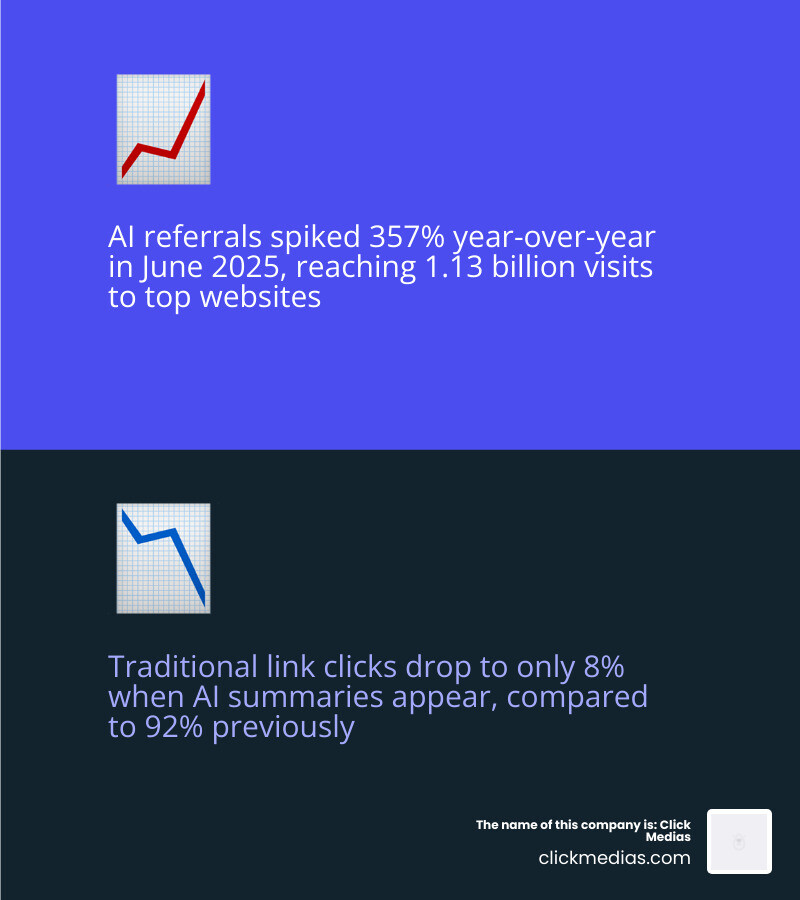
- AI referrals spiked 357% year-over-year in June 2025, reaching 1.13 billion visits to top websites
- About 50% of Google searches already show AI summaries, expected to rise to 75% by 2028
- When AI summaries appear, users click traditional links only 8% of the time
- By 2028, $750 billion in US revenue will flow through AI-powered search
- Unprepared brands may lose 20-50% of their traditional search traffic
The rules have changed. Your content can rank #1 in Google and still be invisible to potential customers who ask AI assistants for recommendations.
Small businesses face the steepest challenge. While you’re optimizing for keywords, your competitors are being cited by ChatGPT. While you’re tracking rankings, they’re capturing the 44% of users who now prefer AI-powered search as their primary research tool.
The good news? You don’t need a massive team or budget to compete. Research shows that a 50-person company can outperform a 50,000-person enterprise in AI visibility through better content structure and topical depth. Domain authority matters less than it used to. Clear answers matter more.
This guide shows you how to build an AI search content strategy that gets your brand mentioned, cited, and recommended by the platforms your customers are already using.
Understanding the Shift: From Keywords to AI-Powered Findy
We are witnessing a tectonic shift in how the internet functions. For twenty years, we played the “10 blue links” game. Today, we are entering the era of Generative Engine Optimization (GEO) and Answer Engine Optimization (AEO).
In the past, SEO was about matching keywords to help a user find a page. Now, an ai search content strategy must focus on helping a machine understand your expertise so it can synthesize an answer for the user. According to Winning in the age of AI search – McKinsey, brands that fail to adapt risk losing a share of a $750 billion revenue shift.
To win, we must understand the three pillars of modern visibility:
| Feature | Traditional SEO | AEO (Answer Engine Opt.) | GEO (Generative Engine Opt.) |
|---|---|---|---|
| Primary Goal | Rank #1 for a keyword | Provide a single, direct answer | Be the cited source in an AI summary |
| Output | List of website links | Featured snippets / Voice | Conversational, synthesized text |
| Mechanism | Backlinks & Keywords | Schema & Clear Facts | Topical Authority & Semantic Depth |
| User Intent | Finding a specific site | Getting a quick fact | Completing a complex task |
This evolution introduces “User Intent 2.0.” Instead of just looking for a “CRM,” users are now asking AI, “Which CRM is best for a 5-person startup with a $50 budget that integrates with Slack?” This is a 3-layer model consisting of task intent (what they want to do), format intent (how they want the info), and context intent (their specific constraints).
If your content doesn’t answer all three layers, the AI will simply skip you. This is why “zero-click” searches are rising; if the AI can answer the question using your data without sending the user to your site, it will. Our job is to ensure that even in a zero-click world, our brand is the one the AI trusts and mentions.
Building an AI Search Content Strategy: A Step-by-Step Framework
Creating an ai search content strategy isn’t about throwing away your old blog posts; it’s about restructuring them into a “canonical” source of truth. AI models like ChatGPT and Gemini don’t just “read” pages; they look for “chunks” of information they can easily extract.
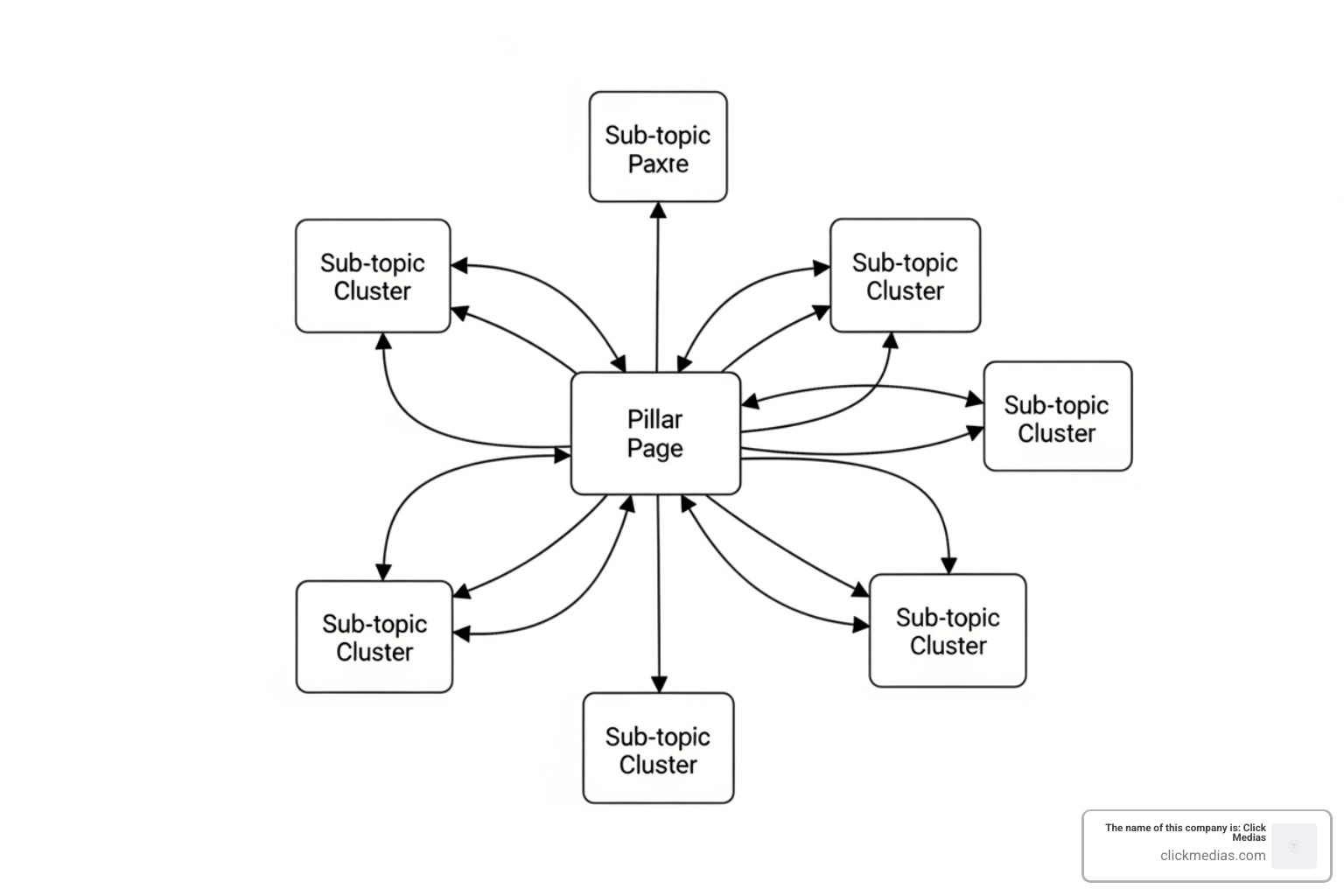
We recommend following a 90-day SEO playbook for AI-driven search visibility to transition your architecture. This framework moves away from scattered articles toward a “Hub and Pillar” model.
- Content Hubs: These are your broad topical homes (e.g., “Sustainable Gardening”).
- Pillar Pages: These are comprehensive guides that define a sub-theme (e.g., “The Ultimate Guide to Organic Soil”).
- Topic Clusters: These are specific, long-tail question-based articles that feed into the pillar.
This structure mimics a “knowledge graph.” When we build these clusters, we aren’t just writing for humans; we are providing the AI with a logical map of our expertise. This strengthens our E-E-A-T (Experience, Expertise, Authoritativeness, and Trustworthiness) signals, which generative systems use to decide which sources are reliable enough to cite.
Identifying Topical Gaps for Your AI Search Content Strategy
The biggest mistake we see is brands assuming they have “enough” content. AI search thrives on entity-level depth. If you sell “Quiet Dishwashers,” but you don’t have a section specifically explaining why 42 dB is the industry gold standard for open-concept kitchens, you have a gap.
To find these gaps, we use tools like Topic Explorer and Content Fusion. We look for:
- Conversational Prompts: What are people asking AI assistants that they aren’t typing into Google? (e.g., “How do I fix a leaky faucet without a wrench?”)
- Semantic Retrieval: Are we using the synonyms and related concepts the AI expects? If we talk about “running shoes,” are we also mentioning “gait analysis,” “midsole cushioning,” and “pronation”?
- Competitor Citations: Who is the AI currently citing for your top-tier questions? If it’s not you, analyze their content structure. Often, they aren’t “better”—they are just clearer.
Structuring Content for AI Citation and Snippet Selection in Your AI Search Content Strategy
Once you’ve found the gaps, you must write in a way that is “extractable.” Think of your content as a series of Lego bricks. The AI wants to grab one brick (a definition, a list, or a table) and plug it into its answer.
We use the Chunk, cite, clarify, build: A content framework for AI search methodology:
- Chunk: Break walls of text into small, self-contained sections.
- Cite: Use explicit facts and data points that are easy to verify.
- Clarify: Use H2 and H3 headers that are phrased as direct questions (e.g., “What are the benefits of X?”).
- Build: Follow every question with a “direct answer” in the first 2-3 sentences.
An “answer-first” layout is critical. If a user asks “How loud is this dishwasher?”, don’t make them read four paragraphs about the history of the brand. Start with: “This dishwasher operates at 42 dB, which is quieter than a normal conversation.” This is a canonical statement—a clear, factual claim that an AI can confidently quote.
Technical Foundations: Schema and Semantic Clarity
While the words on the page matter, the “code” behind them is the secret sauce of an ai search content strategy. schema.org provides a universal language that helps AI systems understand exactly what your content is about.
Microsoft has confirmed that schema helps its Large Language Models (LLMs), like Copilot, better interpret and present your content. Without it, the AI has to “guess.” With it, you are handing the AI a map.
We focus on three high-impact schema types:
- FAQ Schema: This labels your questions and answers, making them 100% parseable for AI Overviews.
- Product Schema: Essential for e-commerce, this ensures the AI knows your price, availability, and specific features.
- HowTo Schema: Perfect for guides, this breaks your content into a numbered list that an AI can read aloud to a user.
Semantic richness is also about punctuation and formatting. AI models prefer simple, clear sentences. Avoid “fluff” and jargon. Instead of saying “Our paradigm-shifting solution facilitates improved synergy,” say “Our tool helps teams work together faster.” The latter is much easier for an AI to summarize accurately.
Measuring Success in the Age of Generative Engines
Traditional KPIs like “keyword rankings” are becoming vanity metrics. If you rank #1 but the AI summary answers the question and the user never clicks, does that ranking matter? Probably not.
In 2026, we track what actually drives revenue. According to LLM optimization in 2026: Tracking, visibility, and what’s next for AI discovery, we should focus on:
- Answer-Share: How often does your brand appear when someone asks a category-level question (e.g., “What are the best CRM tools?”)?
- Citation Rate: How many times do AI platforms like Perplexity or ChatGPT link back to your site as a source?
- AI-Referral Conversions: Users coming from AI search are often further down the funnel. They’ve already done their research; they are coming to you to buy. We track these as high-intent leads.
- Assisted Pipeline Velocity: For B2B firms, being mentioned in AI Overviews has been shown to lift pipeline velocity by 18%.
Using tools like RankBee, we can generate visibility reports that show exactly how our brand is being perceived by different models. ChatGPT might see you as a “budget option,” while Gemini sees you as a “premium leader.” Our ai search content strategy must harmonize these signals.
Frequently Asked Questions about AI Search
What is the difference between SEO and GEO?
SEO (Search Engine Optimization) focuses on ranking a specific URL in a list of results on a search engine like Google. GEO (Generative Engine Optimization) focuses on getting your content’s information included in a synthesized answer generated by an AI. SEO cares about clicks; GEO cares about being the “trusted source” the AI quotes.
How does AI search impact website traffic and conversions?
Initially, you may see a decline in raw traffic (anywhere from 20% to 50%) as AI answers simple questions directly on the search page. However, the traffic that does click through is usually much higher quality. These users have been “pre-sold” by the AI’s recommendation, leading to higher conversion rates and better-assisted pipeline velocity.
Which content formats are most likely to be cited by AI models?
AI models love structure. The most cited formats are:
- Lists and Tables: For easy comparison.
- FAQ Sections: For direct question-answering.
- Step-by-Step Guides: For task-oriented queries.
- Case Studies with Data: For authoritative proof points.
- Glossaries: For defining industry entities.
Conclusion
The rise of AI search is not the end of content marketing; it is a “tectonic shift” that rewards clarity, structure, and genuine expertise. At Click Medias, we specialize in AI Search Optimization (AISO), helping brands steer this new landscape. We don’t just optimize for Google; we ensure your brand is the “canonical answer” for ChatGPT, Gemini, and beyond.
To future-proof your brand, start by auditing your current content for “extractability.” Consolidate your thin posts into authoritative pillars, implement robust schema, and prioritize an answer-first layout. The brands that act now will capture the lion’s share of that $750 billion revenue shift.
Are you ready to see how your brand stacks up in AI?
